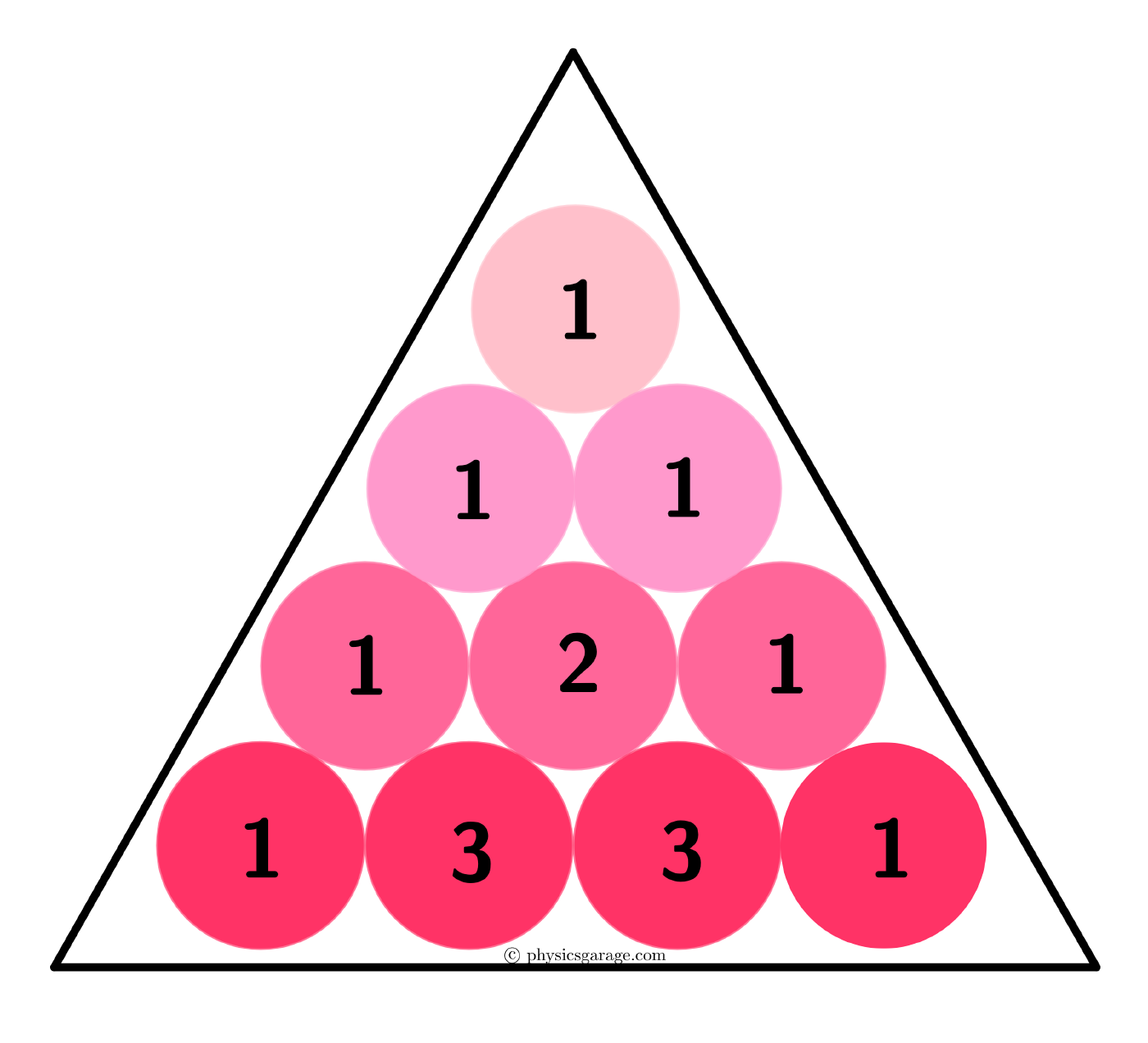
Another Proof of The Binomial Theorem
The Binomial Theorem has been a topic of great interest in mathematics for over 2000 years. It has been explored by the greatest of mathematicians of their respective ages. Over the course of its development, many proofs have been made available. Many of those proofs can be found in modern textbooks, and can be understood with relative ease.
In this article we are going to see a proof that is (relatively) uncommon, while being equally simple if not simpler than the standard methods.
The Prelude
Before we introduce the binomial theorem, let us begin by understanding the problem we are trying to solve here. The expansion of a term like $(x+y)^2$ can easily be obtained by using distributive property of ordinary multiplication as:
$$(x+y)^2 = (x+y)(x+y) = x^2 + 2xy + y^2.$$
In a similar manner, by using this result, we could obtain the expansion of $(x+y)^3$ as:
$$\begin{aligned}(x+y)^3 &= (x+y)^2(x+y) \\ &= (x^2 + 2xy + y^2)(x+y) \\ &= x^3 + 3x^2y + 3xy^2 + y^3,\end{aligned}$$
and so on.
It is not difficult to observe the algorithm here, and all the subsequent expansions of higher powers can easily be obtained. Even if we find the algorithm to be easy to operate, it may not be very efficient for cases where the power is, say, greater than 10. What we desire is an algorithm that can bypass most of the intermediate multiplications, and can lead us to the final expansion without too much effort. This efficient algorithm is described by the binomial theorem.
The Binomial Theorem
According to the theorem, the expansion of the term $(x+y)^n$ is given by:
$$\begin{aligned}(x+y)^n &= \mathcal{C}(n, 0)\cdot x^n + \mathcal{C}(n, 1)\cdot x^{n-1}\cdot y \\ &+ \mathcal{C}(n, 2)\cdot x^{n-2}\cdot y^2 + \cdots + \mathcal{C}(n, n)\cdot y^n,\end{aligned}$$
where $x, y$ and $n$ could be arbitrary numbers in general. However, for this article we will consider only the case of $n$ being a positive integer.
The coefficients $\mathcal{C}(m, n)$ on the right-hand-side are called binomial coefficients, and our main task is to find their values. If we compare this general expansion with examples in the previous section, we can make a simple observation -
All binomial coefficients are integers, depending only on the value of $n$
So, if we can figure out a relationship between $n$ and the binomial coefficients, our problem is essentially solved.
Finding The Binomial Coefficients
Let us begin with the coefficients that are trivial to obtain. The binomial expansion is given as:
$$\begin{aligned}(x+y)^n &= \mathcal{C}(n, 0)\cdot x^n + \mathcal{C}(n, 1)\cdot x^{n-1}\cdot y \\ &+ \mathcal{C}(n, 2)\cdot x^{n-2}\cdot y^2 + \cdots + \mathcal{C}(n, n)\cdot y^n.\end{aligned}$$
The First Coefficient
If we put $y=0$ on both sides, we get: $$x^n = \mathcal{C}(n, 0)\cdot x^n + 0 + 0 + \cdots + 0.$$ By comparing the coefficient of $x^n$ on both sides we get the first coefficient as: $$\mathcal{C}(n, 0) = 1$$
The Last Coefficient
Similarly, if we put $x=0$ on both sides, we get: $$y^n = 0 + 0 + \cdots + \mathcal{C}(n, n)\cdot y^n.$$ By comparing the coefficient of $y^n$ on both sides we get the last coefficient as: $$\mathcal{C}(n, n) = 1$$
The Second Coefficient
In order to find this, we need to invoke the distributive property of multiplication. We write the left-hand-side as:
$$\begin{aligned}(x+y)^n &= (\red{x}+\blue{y}) \cdot (x+y)^{n-1} \\ &= \red{x}\cdot(x+y)^{n-1} + \blue{y}\cdot(x+y)^{n-1}\end{aligned}$$
We can now individually expand the two terms on the right-hand-side of this equation by using the binomial theorem. The first term becomes:
$$\begin{aligned} \red{x}\cdot(x+y)^{n-1} &= \red{x} \cdot \mathcal{C}(n-1, 0)\cdot x^{n-1} \\ &~~~~ + \red{x} \cdot \mathcal{C}(n-1, 1)\cdot x^{n-2}\cdot y + \cdots \\ &= \mathcal{C}(n-1, 0)\cdot x^{n} \\ &~~~~ + \mathcal{C}(n-1, 1)\cdot \green{x^{n-1}\cdot y} + \cdots,\end{aligned}$$
while the second term becomes:
$$\begin{aligned}\blue{y}\cdot(x+y)^{n-1} &= \blue{y} \cdot \mathcal{C}(n-1, 0)\cdot x^{n-1} \\ &~~~~ + \blue{y} \cdot \mathcal{C}(n-1, 1)\cdot x^{n-2}\cdot y + \cdots \\ &= \mathcal{C}(n-1, 0)\cdot \green{x^{n-1} \cdot y} \\ &~~~~ + \mathcal{C}(n-1, 1)\cdot x^{n-2}\cdot y^2 + \cdots. \end{aligned}$$
After we sum the two expansions on the right-hand-side, the coefficient of $\green{x^{n-1} \cdot y}$ is simply given by: $~~~\mathcal{C}(n-1, 1) + \mathcal{C}(n-1, 0).$
Now, for the left-hand-side we already obtained the expansion as:
$$\begin{aligned}(x+y)^n &= \mathcal{C}(n, 0)\cdot x^n + \mathcal{C}(n, 1)\cdot \green{x^{n-1}\cdot y} \\ &~~~~ + \mathcal{C}(n, 2)\cdot x^{n-2} \cdot y^2 \\ &~~~~ + \cdots + \mathcal{C}(n, n)\cdot y^n,\end{aligned}$$
from which we can also obtain the coefficient of $\green{x^{n-1} \cdot y}$ as: $~~~\mathcal{C}(n, 1).$
We can equate these two coefficients to get:
$$\mathcal{C}(n, 1) = \mathcal{C}(n-1, 1) + \mathcal{C}(n-1, 0). $$
Now, we can use the fact that $\mathcal{C}(n, 0) = 1$ for all values of $n$, to simplify the previous expression and get:
$$\mathcal{C}(n, 1) = \mathcal{C}(n-1, 1) + 1.$$
This equation is true for all positive integer values of $n$, which means we can replace $n$ with $(n-1)$ on both sides without changing anything:
$$\mathcal{C}(n-1, 1) = \mathcal{C}(n-2, 1) + 1.$$
This equation can be substituted back into the previous equation to get:
$$\mathcal{C}(n, 1) = \mathcal{C}(n-2, 1) + 1 + 1.$$
In fact, we can do this kind of substitution again to replace the first term on the right-hand-side to get:
$$\mathcal{C}(n, 1) = \mathcal{C}(n-3, 1) + 1 + 1 + 1.$$
If we continue to do this substitution until the first term becomes $\mathcal{C}(1, 1)$, we would get:
$$\mathcal{C}(n, 1) = \mathcal{C}(1, 1) + 1 + 1 + 1 + \cdots (n-1)\text{ times}.$$
By using the fact that $\mathcal{C}(1, 1) = 1,$ we get:
$$\begin{aligned}\mathcal{C}(n, 1) &= 1 + 1 + 1 + 1 + \cdots n\text{ times}\\ &= n \end{aligned}$$
Therefore, we have obtained the second coefficient of the binomial expansion to be:
$$\mathcal{C}(n, 1) = n$$
The General Formula
If we follow the steps described in the previous section, we can naturally obtain the next (third) coefficient $\mathcal{C}(n, 2)$, by comparing the coefficients of $x^{n-2} \cdot y$. The corresponding algebra is straightforward but turns out to be increasingly tedious. Here, we wish to find another way to obtain the coefficients in a relatively simpler manner.
Let us consider a term like -
$$((1+x) + y)^n,$$
which can be re-written as:
$$((1+x) + y)^n = (1+ (x + y))^n.$$
It might seem that we have arbitrarily invoked a special term, and all the results that follow could only be true for this special case. Well, we are already aware that the binomial coefficients are only dependent on the power $n$, and not on the terms inside the base. So, in principle, we can choose to work with any kind of (valid) term as long as the power remains the same.
The binomial expansion of the left-hand-side is easy to obtain, and given by:
$$\begin{aligned}&\mathcal{C}(n, 0)(1+x)^n \cdot y^0\\ + &\mathcal{C}(n, 1) \cdot (1+x)^{n-1} \cdot y^1 \\ + &\mathcal{C}(n, 2) \cdot (1+x)^{n-2} \cdot y^2 \\ + &\mathcal{C}(n, 3) \cdot (1+x)^{n-3} \cdot y^3 \\ + &\cdots \\ + &\mathcal{C}(n, r-1) \cdot (1+x)^{n-r+1} \cdot y^{r-1} \\ + &\mathcal{C}(n, r) \cdot (1+x)^{n-r} \cdot y^r \\ + &\cdots \\ + &\mathcal{C}(n, n) \cdot (1+x)^{0} \cdot y^n\end{aligned}$$
Similarly, the binomial expansion of the right-hand-side is given by:
$$\begin{aligned}&\mathcal{C}(n, 0) \cdot (x+y)^0\\ + &\mathcal{C}(n, 1) \cdot (x+y)^1 \\ + &\mathcal{C}(n, 2) \cdot (x+y)^2 \\ + &\mathcal{C}(n, 3) \cdot (x+y)^3 \\ + &\cdots \\ + &\mathcal{C}(n, r-1) \cdot (x+y)^{r-1} \\ + &\mathcal{C}(n, r) \cdot (x+y)^r \\ + &\cdots \\ + &\mathcal{C}(n, n) \cdot (x+y)^n \end{aligned}$$
These expansions might look very complicated, but fortunately for us, we only need one term each from these expansions to solve our problem.
Consider the $r$-th term from the expansion of the right-hand-side:
$$\mathcal{C}(n, r) \cdot (x+y)^r.$$
By interchanging $x$ and $y$, this term can further be expanded as:
$$\mathcal{C}(n, r) \cdot (y+x)^r = \mathcal{C}(n, r) \cdot (y^r + \mathcal{C}(r, 1) \cdot y^{r-1} \cdot x + \cdots).$$
We are only interested in the coefficient of $x \cdot y^{r-1}$, which is given by:
$$\red{\mathcal{C}(n, r) \cdot \mathcal{C}(r, 1)}.$$
It might seem that we have ignored possibly more coefficients of $x \cdot y^{r-1}$ from other terms in the expansion, but it can be checked (easily) that only the $r$-th term contains the factor of $x \cdot y^{r-1}$.
We also need the coefficient of $x \cdot y^{r-1}$ from the left-hand-side, which is obtained from the $(r-1)$-th term in the expansion:
$$\mathcal{C}(n, r-1) \cdot (1+x)^{n-r+1} \cdot y^{r-1}.$$
If we expand this term using the binomial theorem, we get:
$$\mathcal{C}(n, r-1) \cdot (1+x)^{n-r+1} \cdot y^{r-1} = \mathcal{C}(n, r-1) \cdot (1 + \mathcal{C}(n-r+1, 1) \cdot x + \cdots) \cdot y^{r-1}.$$
Therefore, the coefficient of $x \cdot y^{r-1}$ is clearly:
$$\red{\mathcal{C}(n, r-1) \cdot \mathcal{C}(n-r+1, 1)}.$$
Now, we can equate the two coefficients, to get:
$$\mathcal{C}(n, r) \cdot \mathcal{C}(r, 1) = \mathcal{C}(n, r-1) \cdot \mathcal{C}(n-r+1, 1)$$
This equality can be simplified by using the fact that $\mathcal{C}(n, 1) = n$, to get:
$$\mathcal{C}(n, r) \cdot r = \mathcal{C}(n, r-1) \cdot (n-r+1)$$
Finally, we can extract the general binomial coefficient to be:
$$\mathcal{C}(n, r) = \frac{(n-r+1)}{r} \cdot \mathcal{C}(n, r-1) $$
If we recall a trick used earlier, we can make a repeated substitution to get:
$$\begin{aligned}\mathcal{C}(n, r) &= \frac{(n-r+1)}{r} \cdot \mathcal{C}(n, r-1) \\ &= \frac{(n-r+1)}{r} \cdot \frac{(n-r+2)}{r-1} \cdot \mathcal{C}(n, r-2) \\ &= \frac{(n-r+1)}{r} \cdot \frac{(n-r+2)}{r-1} \cdot \frac{(n-r+3)}{r-3} \cdot \mathcal{C}(n, r-3) \\ &= \frac{(n-r+1)}{r} \cdot \frac{(n-r+2)}{r-1} \cdot \frac{(n-r+3)}{r-3} \cdots \cdot \frac{(n-1)}{2} \cdot \frac{n}{1} \\ \end{aligned}$$
We can slightly rearrange this expression to get:
$$ \mathcal{C}(n, r) = \frac{n \cdot (n-1) \cdot (n-2) \cdot (n-3) \cdots (n-r+1)}{1 \cdot 2 \cdot 3 \cdots r} $$
By using this expression, we can determine all the binomial coefficients for any given positive integer power. For example:
$$\begin{aligned} \mathcal{C}(n, 1) &= \frac{n}{1},\\ \mathcal{C}(n, 2) &= \frac{n\cdot(n-1)}{1 \cdot 2},\\ \mathcal{C}(n, 3) &= \frac{n\cdot(n-1)\cdot(n-2)}{1 \cdot 2 \cdot 3}, \\ \mathcal{C}(n, 4) &= \frac{n\cdot(n-1)\cdot(n-2)\cdot(n-3)}{1 \cdot 2 \cdot 3 \cdot 4}, \end{aligned}$$
and so on.
Feel free to send in your questions/comments/feedback here
SubscribeRelated Posts

Another Approach To Understand Accelerated Motion
Motion of a moving particle is considered to be one of the most instructive and useful physical systems one can study.
Read more